On a hazy spring morning in Saudi Arabia, mirrored walls still shimmer above the sand. They rise like a digital illusion glitched into the desert — reflecting dunes, cranes, and small groups of workers beneath the heat. This was meant to become “The Line,” a 170-kilometre, ruler-straight megacity without cars or traditional streets, a climate-controlled urban experiment sealed behind glass.
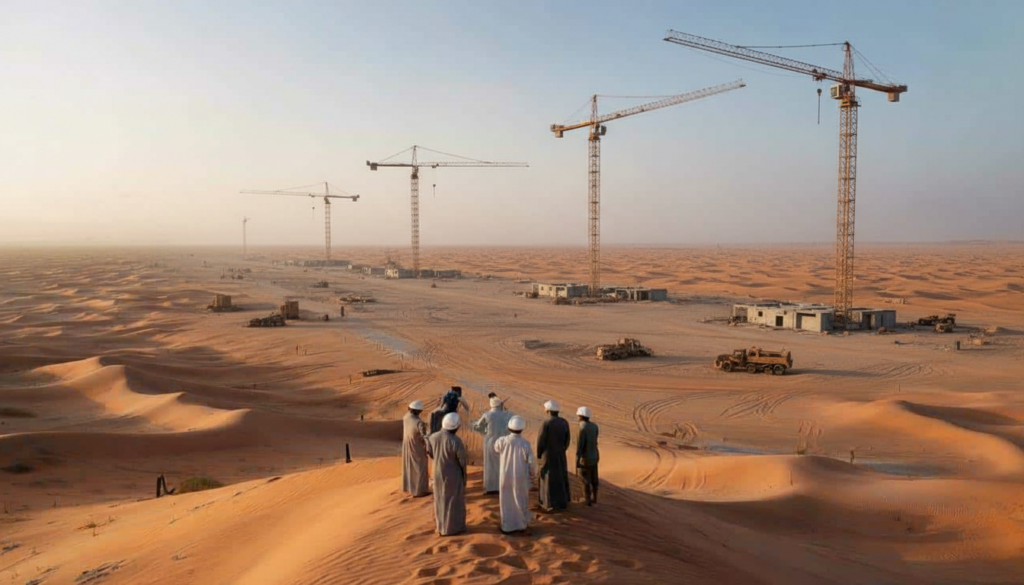
Today, the ambition looks different. The original 100-mile vision has quietly narrowed to a short initial stretch — a few kilometres instead of a continuous mirrored corridor slicing across the desert. The idea hasn’t vanished. But reality has clearly negotiated new terms.
From 170 Kilometres to a Phased Beginning
There was no dramatic cancellation, no sweeping royal announcement declaring the dream over. Instead, the shift arrived in subtle language: “phased rollout,” “priority development,” “initial zone.” Those phrases began replacing bold claims of a seamless 170-kilometre urban revolution.

What once appeared as a fully mapped megacity now resembles a prototype planted in sand.
For years, polished animations showed a futuristic corridor housing nine million people in a structure just 200 meters wide and 500 meters tall. High-speed underground transit, vertical farms stacked like digital blocks, drone taxis gliding overhead — it was less city and more science fiction storyboard.
But by early 2024, satellite images told a quieter story. Construction was concentrated in a small segment. Reports from international media suggested scaled-down population targets and a slower build timeline. The gap between presentation and progress became harder to ignore.
Grand visions met practical limits: engineering complexity, financial trade-offs, global investor scrutiny, and the sheer logistical weight of building a hyper-dense city in extreme desert conditions.
Blueprint for the Future or Architectural Mirage?
Conversations about NEOM — the larger region that includes The Line — now carry mixed emotions. There is still pride in the ambition. But there is also a subtle pause before confidence.
Was The Line primarily an urban innovation, or was it a symbolic reset button for Saudi Arabia’s global image?
Supporters argue it forces overdue questions about car dependency, urban sprawl, and carbon emissions. Radical ideas often sound impossible before they become normal. Skyscrapers once seemed absurd. Underground metros were ridiculed before they reshaped cities.
Critics, however, see a different narrative. They describe The Line as an example of techno-utopian thinking — architecture attempting to leapfrog social, environmental, and political realities. Human rights organizations have raised concerns about relocations in the NEOM region, challenging whether sustainability can exist without social consent.

The Global Lesson Hidden in the Scale-Back
If you step outside the spectacle, there’s a broader takeaway for cities worldwide. The reduced version of The Line functions like a massive pilot project. And that shift might be the most rational development of all.
What if the original announcement had framed it as a 5-kilometre experimental district first? Expectations would have been grounded. Criticism might have softened. Scaling would follow performance, not animation.
Many megaprojects stumble because they attempt to leap from concept to monument without testing assumptions. Cities evolve organically. They resist rigid blueprints that try to predict how millions will live decades into the future.
The nine-million-resident promise sounded powerful — but it also demanded answers: Who relocates? What industries anchor the economy? What happens if population growth falls short?
Scaling down isn’t always failure. Sometimes it’s discipline returning to ambition.
Between Visionary Leap and Costly Overreach
The debate around The Line is far from settled. In fact, the shorter build may intensify it. If the initial stretch proves livable, sustainable, and economically vibrant, supporters will argue that the concept was sound — only prematurely oversized. If it struggles to attract residents or becomes an isolated luxury corridor, critics will claim the original vision was always detached from practical reality.
Mega-announcements rarely function as literal blueprints. They operate as signals. Saudi Arabia’s message was clear: we aim to diversify, innovate, and redefine our global narrative beyond oil.
In that sense, The Line has already influenced perception. Whether the final structure spans kilometres or shrinks further, it has reshaped the conversation around what cities might attempt.
| Key point | Detail | Value for the reader |
|---|---|---|
| Phased reality | The Line is moving from a 170 km promise to a short, testable segment. | Helps you see how grand visions adapt once they collide with budgets and physics. |
| Symbol vs. city | The project functions as both real estate and a narrative tool for Saudi rebranding. | Invites you to question how much of any megaproject is about politics and image. |
| Lessons for future plans | Prototype first, stay flexible, and center how people truly live. | Offers a mental checklist for judging the next “city of the future” you see online. |