The violent change in gold and silver prices on Friday shocked the markets. This happened right after Donald Trump named his choice to lead the US Federal Reserve. Earlier in the week, it looked like a typical “panic into safety” trade, but now it’s a race to lock in profits.
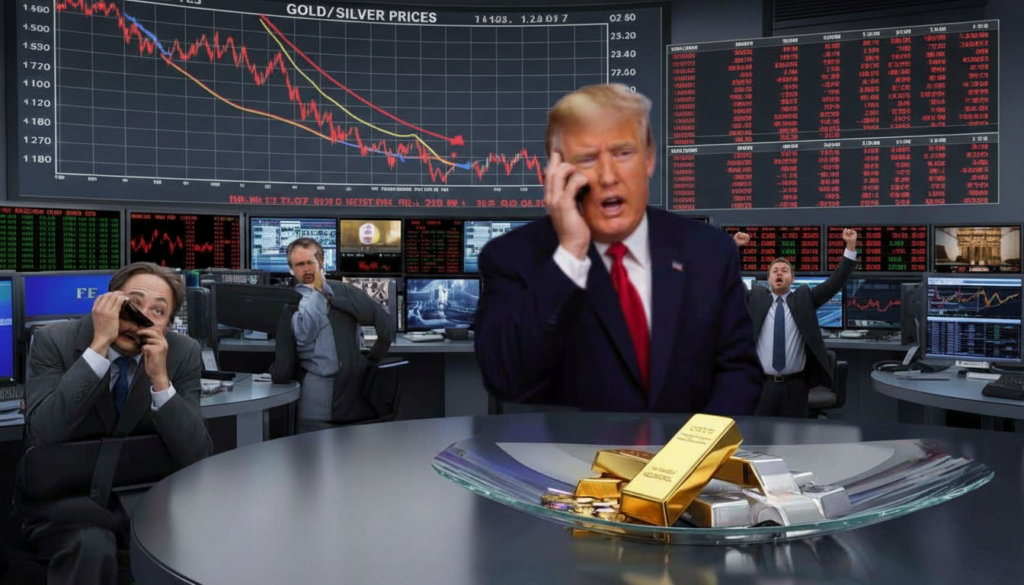
Gold and silver prices go up to record highs and then drop sharply.
By early afternoon, the drop in the price of precious metals was very bad. Gold, which had been breaking records, fell 6.27% to about $5,037.91 an ounce. Earlier in the session, it had been down more than 8%.
It hit silver even harder. The metal fell 14.30% to about $99.15 an ounce after briefly dropping more than 17.6%. It is both a safe haven and a heavy industrial use.

The quick reversal shows how quickly trades based on fear can end when one political signal calms investors.
This correction comes right after the metals’ amazing rise. The day before, gold had reached a record high of about $5,595 an ounce, and silver had reached a high of about $121.65 an ounce.
From fear of losing money to making money
Analysts say that the size of Friday’s drop shows that a lot of traders were just waiting for a reason to take profits after the parabolic move earlier in the week. Investors had moved into anything that seemed solid, real, and outside the normal financial system because they were worried about instability around the world and political uncertainty in the US.
Those same investors now seem to be getting out of their positions after getting a political signal they see as reassuring: Trump wants to name Kevin Warsh, a former Fed governor, as the next chair of the central bank.
Why Kevin Warsh’s nomination is important for gold
Trump has attacked the Fed and its outgoing chair Jerome Powell many times, calling for lower interest rates and criticizing the central bank on social media and at rallies. That pressure made people worry that the Fed’s independence was weakening, which usually makes people want to buy hard assets like gold and silver.
Warsh, on the other hand, is seen as a more traditional choice with strong opinions on the independence of central banks and the credibility of institutions. That makes a big difference for the markets.
Traders think Warsh is independent enough not to be used as a political tool, which takes some of the heat out of the “panic gold” story.
Analysts say that the market is basically changing the price of the risk that the Fed could become a tool of the White House. When institutions feel more independent, investors don’t feel as strongly that they need to protect themselves against losing faith in the dollar and US monetary policy.
How the independence of the central bank affects metal prices
When investors are afraid that a central bank might give in to political pressure, they are afraid of:
- More inflation if rates stay low for too long
- Over time, the currency’s credibility will go down.
- Changes in policy that weren’t expected because of politics, not data
- More ups and downs in the bond and currency markets
That worry tends to help gold and silver. You can’t print them, and they aren’t linked to any government. Demand can drop quickly after those worries go away, especially after prices have gone up quickly.
After a big rally, safe-haven assets lose value.
The most recent drop in precious metals comes after a huge rise since the beginning of the year. Gold prices went up almost 30% from January to Thursday’s peak. Silver had gone up by almost 70% because of safe-haven flows and strong demand from solar and electronics manufacturers.

When investors were looking for “real” assets that were thought to be more stable than paper currencies during times of geopolitical and economic stress, industrial metals like copper also rose.
The change from record highs to big losses shows how quickly safe-haven trades can turn around when a political shock absorber shows up.
Important numbers at a glance
| Metal | Recent record high (per oz) | Current level (Friday) | One-day move | Gain from start of year to record |
|---|---|---|---|---|
| Gold | ≈ $5,595 | ≈ $5,038 | -6.27% | ~ +30% |
| Silver | ≈ $121.65 | ≈ $99.15 | -14.30% | ~ +70% |
A lot of short-term traders set automatic sell orders or just wait for a good reason to close their positions when prices go up that fast. Warsh’s nomination gave them that reason. The result was a wave of selling that kept going as stop-loss orders were triggered, which made more investors sell in a falling market.
Some market strategists say that this move doesn’t mean that the long-term bullish story for gold and silver is over. People are still worried about government debt, inflation, and tensions between countries. But looking back, the extreme rush to safety that happened earlier in the week seems too much.
What this means for regular investors
If you are a small investor who owns gold or silver through exchange-traded funds or coins, Friday’s price action is a harsh reminder of how unstable “safe havens” can be. The label can be misleading: they may protect against some long-term risks, but they can still swing wildly from day to day.
Financial planners often say that if investors want to keep precious metals, they should only make up a small part of a larger portfolio instead of being the main holding.
Gold can protect against shocks, but its price is based on both emotions and economics.
Why silver acts differently than gold
Silver’s drop looks especially bad because the metal is both a financial asset and an industrial input. When fear takes over, silver can do better than gold as more people buy it as an investment. Silver can quickly lose value when sentiment changes and worries about growth rise because industrial demand is more sensitive to the economy.
The recent rise in the use of solar panels and the production of electronics helped push silver prices up earlier this year. The sudden change makes it seem like at least part of that rally was based on speculation rather than just the facts.
Important words and risks that investors should know
A few ideas can help you make sense of these moves:
- A safe-haven asset is a financial asset that usually keeps its value or goes up when the markets are in a panic. Examples include gold, top-rated government bonds, and some currencies, like the Swiss franc.
- Independence of the central bank: how much a central bank can set interest rates without having to worry about short-term political pressure. People think that independence helps keep currencies stable and may lower the demand for gold.
- Profit-taking means selling assets after a big rise, not always because of a change in fundamentals, but to lock in gains and lower risk.
- Speculative positioning is when big investors make big bets based on what they think will happen to prices in the future. If a lot of bets are going in the same direction, reversals can be very violent.
When the market suddenly drops, investors who want to buy often don’t think about how risky it is that it will keep going up and down. If the first rally was based on emotion and leverage, a sharp drop doesn’t always mean a good deal. Traders who borrow money may have to quickly sell their positions, which can cause prices to go higher or lower than what the fundamentals would suggest.
One way for long-term savers who still want some gold exposure to do this is to set a fixed percentage of their portfolio that they are comfortable with ahead of time. Then, instead of reacting to headlines, they should rebalance their portfolio over time. That way, they don’t have to chase the latest swing; instead, they sell a little when gold goes up and buy a little when it goes down.