At 8:57 a.m., Emma slides her coffee mug next to her laptop and hits “Join meeting” in a faded band T‑shirt. Her cat is snoring on the printer. Outside, the garbage truck whines down the street. Inside, 12 tiny faces appear in a grid, some still in pajamas, one with a toddler on his lap who refuses to leave the frame. The meeting stumbles to life, half chaos, half quiet efficiency. No commute. No racing for a train. No lukewarm office coffee. Just work, squeezed into real life.
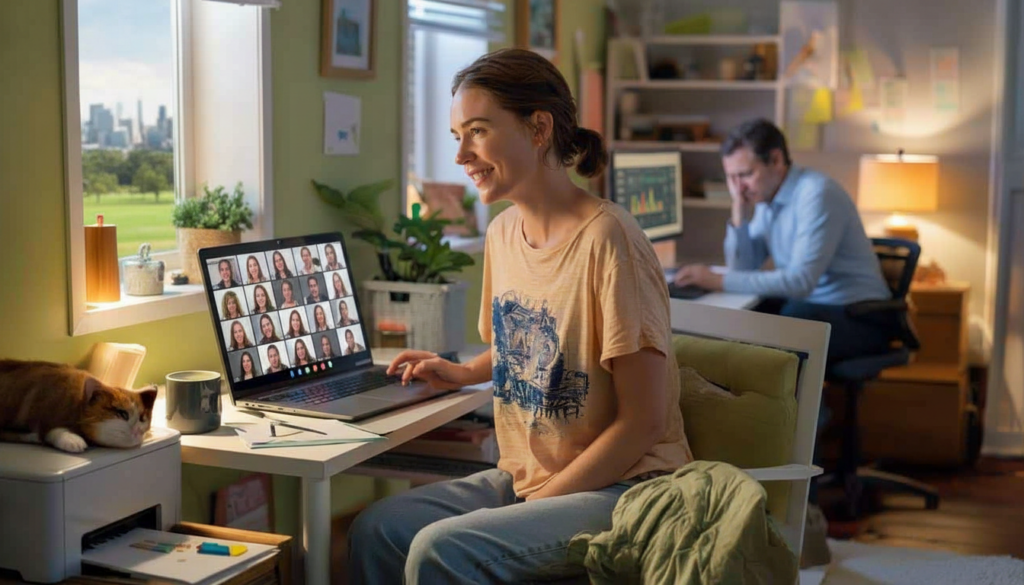
The call ends at 9:22 a.m. Emma clicks “Leave,” stretches, swaps laundry, then gets back to her spreadsheet with a smile she never had in the open‑plan office.
Four years of data, one clear feeling: home is better
When the world shut down in 2020, millions of people suddenly learned what their day was like without badge swipes and fluorescent lights. It felt like a strange experiment at first. Then the researchers figured out that this was the biggest study of work ever, happening in real time on every continent and in every industry.

Economists, psychologists, and sociologists began to follow people week after week. How much stress did they have? What time did they go to bed? Did their managers respect them or keep an eye on them? The question behind all the charts was simple, like a child’s question.
Where do people feel good about themselves?
For more than four years, research teams at Stanford, the London School of Economics, and a few national labour institutes looked at surveys from hundreds of thousands of workers. One project that spanned several countries followed the same employees as they moved from working full-time in an office to working from home, then to a hybrid model, and finally back to the office. The pattern was hard to change.
People who worked from home said they were happier with their lives, less stressed, and slept better on average. Not just in tech, but also in marketing, insurance, support roles, and even some public services. A big study found that people saved 60 to 90 minutes a day by not having to drive to work.
That time didn’t go away. It slowly turned into breakfast with the kids, walks, workouts, and yes, more sleep.
Researchers tried to poke holes. Was it only young workers? Just parents. Only people who make a lot of money. The main result stayed the same every time they changed the data. People who worked from home felt like they had more control over their time, even though they worked the same number of hours.
They said they had fewer small stressors, like no loud open spaces, fewer pointless interruptions, and less “performing” productivity. One psychologist said it was like going from “being on stage” to “working in your living room.”
The surprising part. People were happier even though they still liked their jobs.
Why managers tense up when employees relax
Inside HR departments and management Slack channels, the tone has been very different. While workers talk about balance, leaders send long memos about culture, creativity, and “collaboration synergies”. Behind the buzzwords sits a rawer emotion: loss of control.
For decades, management meant seeing people in chairs. The office was a visible scoreboard. Who comes early. Who leaves late. Who looks stressed enough to be “really committed”. With home offices and flexible schedules, that scoreboard shattered overnight.
Take Martin, a mid-level manager in a European bank. Before 2020, his days were a loop of corridor chats, quick desk check-ins, and status meetings that filled the calendar. When his team went fully remote, performance numbers stayed solid. Some even improved. Complaints dropped. Sick days dropped.
But Martin felt strangely… unemployed. No more walks around the floor. No visual scan of who was “on it”. He found himself adding new weekly check-ins, requesting daily updates, asking for cameras to be on “for team spirit”. His team complied, but surveys later showed their stress quietly rising.
Researchers have a term for this tension: management by presence. It’s not about outcomes; it’s about comfort. Many leaders were trained to react to bodies, not results. When those bodies are at home, old habits keep looking for new levers. Return-to-office mandates, fixed days, badge analytics, desk-usage dashboards.
From the data side, it’s blunt. Studies show **no systematic drop in productivity** for remote knowledge work, and in many cases, a modest increase. From the human side, it stings. Managers feel their role shrinking from “leader of a tribe” to “box in a video grid”.
Let’s be honest: nobody really changes a 30‑year management reflex with a single webinar.

So how do we work from home… without blowing up the relationship?
The research is clear: home tends to make people happier. The relationship with the boss, not always. One simple move helps a lot. Turn invisible effort into visible outcomes.
Instead of logging in early and staying late “to be seen”, agree on a small set of measurable outputs with your manager. Weekly goals. Clear deliverables. A shared dashboard both of you can consult without five extra meetings. This shifts the conversation from “Are you online enough” to “Is the work moving”.
Many of us trip over the same traps. Answering every message within two minutes to prove we’re present. Leaving the camera on even when we’re exhausted. Joining “optional” meetings because we’re scared to miss something or look disengaged.
These are survival habits from office culture, replayed in the kitchen. They slowly erase the benefits the scientists are talking about: focus, autonomy, less stress. It’s okay to respond at a human pace, to block focused work time, to say, “Can this be an email” once in a while.
We’ve all been there, that moment when you mute yourself and wonder, “Why am I even in this call.”
There’s also a quiet negotiation happening inside every home: between work, family, and your own head. The happiest remote workers in the studies were not the ones with fancy home offices. They were the ones with a few non‑negotiable rituals.
- Define your “reachable hours” and communicate them clearly.
- Pick one daily ritual that marks the end of work: a walk, a shower, a playlist.
- Say no to at least one unnecessary meeting per week.
- Keep one physical space, however small, that means “work stays here”.
- Once a week, write down what you actually finished, not just what you attended.
*It sounds basic, but this is where the science of happiness meets the mess of real life.*
The future office might be your living room… and your manager’s test
The trend lines are still the same four years after the big remote experiment started. When people can choose where they work, they are happier, less tired, and more committed to their jobs. That doesn’t mean that everyone wants to stay home all the time. A lot of people like going to the office a few days a week because of the buzz, the coffee runs, and the little bit of chaos that comes with sharing space.
The real split is no longer between home and work. It’s not a choice; it’s forced. A commute you choose is very different from one you don’t want to do. A video call you accept for a good reason feels different than one you join “because that’s what we do.” Mental health improves on one side of that line. On the other hand, burnout comes on slowly.
For managers, this is slowly becoming a test of their skills. People who will keep good workers are learning to lead by trust, not by seeing them in the hall. They talk more about results and less about badges. Not just if the KPIs are green, but how people are really living their lives.
Some will change. Some people won’t. People can now tell the difference between their calendars, sleep trackers, and kitchen tables. A job isn’t just a chair and a pay cheque anymore. It’s a set of days that either fits your life or keeps trying to change it.
The scientists have done their part by drawing the curve. Being at home makes us happier. What companies will do with that information is still up in the air. Will offices become places where people want to go instead of places they have to go? Will managers be taught to give up their need to see and learn to listen instead?
And on a smaller, more personal level, what does a good workday look like for you where you actually live? That’s the talk that is just starting in living rooms, video calls, and yes, even a few cubicles.
| Key point | Detail | Value for the reader |
|---|---|---|
| Remote work boosts happiness | Four-year studies show higher life satisfaction, less stress, and better sleep for home workers | Helps you feel less guilty for wanting flexibility and more confident asking for it |
| Managers fear loss of control | Traditional “management by presence” makes leaders uncomfortable when they can’t see people | Lets you understand pushback and prepare calm, outcome-focused conversations |
| Clear rituals and metrics matter | Defining outputs, reachable hours, and end-of-day habits protects the benefits of remote work | Gives you concrete levers to improve your daily life, not just dream about it |
Questions and Answers:
Question 1 : Do people really work as much from home as they do in the office?Yes, most big studies say so. Time saved on the commute often goes to focused work and personal life, which keeps overall productivity the same or even increases it a little.
Question 2: Why do some businesses still want people to come back to the office?Partly because of culture and working together, and partly because of habit and fear of losing control. It takes time to unlearn how to manage by sight instead of by results, which is how many leaders were taught.
Question 3: Is it better for happiness to work full-time from home than in a hybrid setting?Data shows that workers who are happy often have real choices. For a lot of people, spending 2–3 days at home and a few days at work is the best way to balance work and socialising.
Question 4: What if my boss thinks that working from home means “less serious”?Talk about results instead. Keep track of what you deliver, not just the hours you spend online, and share that information often so people can see that you are committed.
Question 5: How can I keep remote work from becoming “always on”?Set clear limits, like status messages, blocked calendar slots, and end-of-day rituals. Let your team know when you’re not available, and then stick to that queue most days.