About 90 square kilometers of desert near Abu Dhabi is where the Khazna Solar PV project is taking shape. Three big energy companies are working on the site: Masdar, French utility Engie, and the Emirates Water and Electricity Company (EWEC).
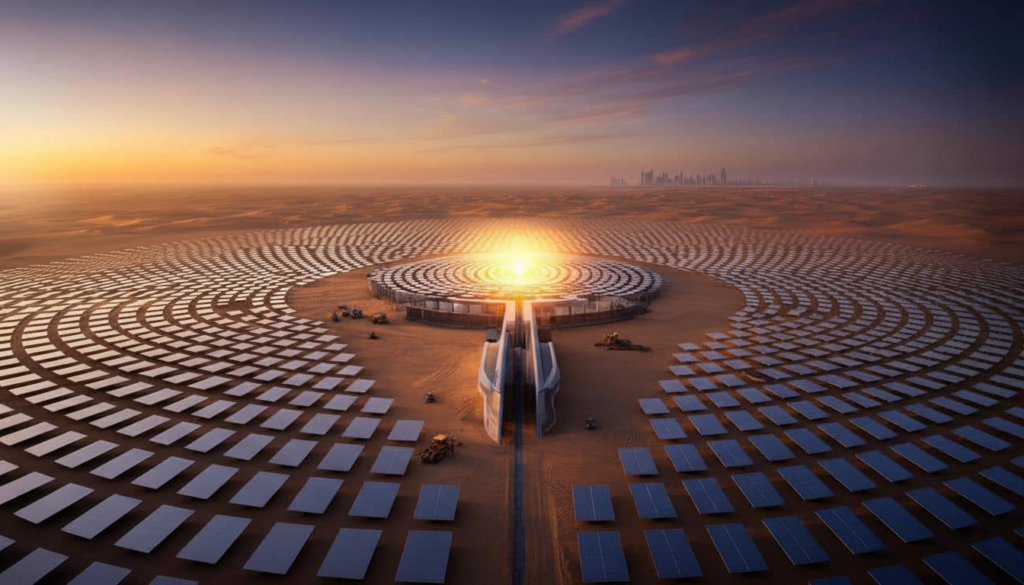
The partners started building this year and have until 2027 to get the plant fully operational. When it’s up and running, Khazna will provide 1.5 gigawatts of low-carbon electricity all the time, day and night.
This is the first time that a single solar site has been designed to provide baseload electricity on this scale, 24 hours a day, 7 days a week.

Three Million Panels and a Lot of Batteries
The main part of the project is a huge photovoltaic park with about three million solar panels arranged in neat rows. When you look at the complex from above, it will look like a dark, shimmering ocean on the sand.
During the day, these panels will turn sunlight into electricity, but the important thing is what happens to that power after it is made. A big part will go straight to the local grid. Another part will go into storage systems that are made to hold energy for use after dark.
The plant will power about 160,000 homes in the Emirates and stop 2.4 million tonnes of CO₂ from being released into the air each year.
How a “Artificial Sun” Works
Solar tracking that follows the sun in real time will be added to every panel at Khazna to get more electricity out of the same amount of space. The panels don’t stay still; instead, they slowly turn during the day to follow the sun’s path across the sky.
This movement lets each panel catch more light, especially in the early morning and late afternoon. In the desert, where the sky is usually clear and the sun is very strong, tracking can increase daily energy output by 15% to 25% compared to fixed installations.
From Power That Comes and Goes to Power That Stays On
Sunlight is still intermittent by nature. The project needs both storage and smart management to turn a resource that changes into a steady output.

When the sun is shining the most, big battery systems store extra solar power. Control algorithms make the decision in real time about whether to send electricity to the grid or to storage. The stored energy goes back onto the grid when demand is highest at night.
What 1.5 Gigawatts Really Means
Gigawatt numbers can seem vague to people who aren’t experts. One billion watts is a gigawatt. In a British kitchen, an average electric kettle uses about 2,000 watts.
| Item | About how much power |
|---|---|
| 10 watts | for a home LED bulb |
| 150 watts | for the fridge-freezer |
| Electric kettle: 2,000 watts | (2 kW) |
| 2 megawatts (2,000,000 W) | for a small wind turbine |
| Khazna’s capacity | 1.5 gigawatts (1,500,000,000 W) |
Frequently Asked Questions (FAQs)
1. How does solar tracking work at Khazna?
The panels rotate during the day to follow the sun’s path, increasing energy output by 15%-25% compared to fixed panels.
2. What is the main goal of the Khazna Solar PV project?
The goal is to provide baseload electricity 24 hours a day using solar energy, powered by both solar power and energy storage systems.
3. How does energy storage help at Khazna?
Energy storage ensures the plant can continue supplying electricity at night or when the sun isn’t shining, maintaining a steady output.
4. Why is Khazna significant for the UAE’s future energy mix?
Khazna represents a shift towards large-scale solar power, reducing reliance on fossil fuels and helping to cut emissions in the Emirates.