Around 4:30 p.m., the first big snowflakes start to float by the office windows. They move slowly and seem to have all the time in the world. The sound of Slack messages and email pings inside feels strangely louder and more aggressive against the sudden quiet outside. Someone in the open space makes a joke about sleeping under their desk if the roads get bad. No one laughs very hard.
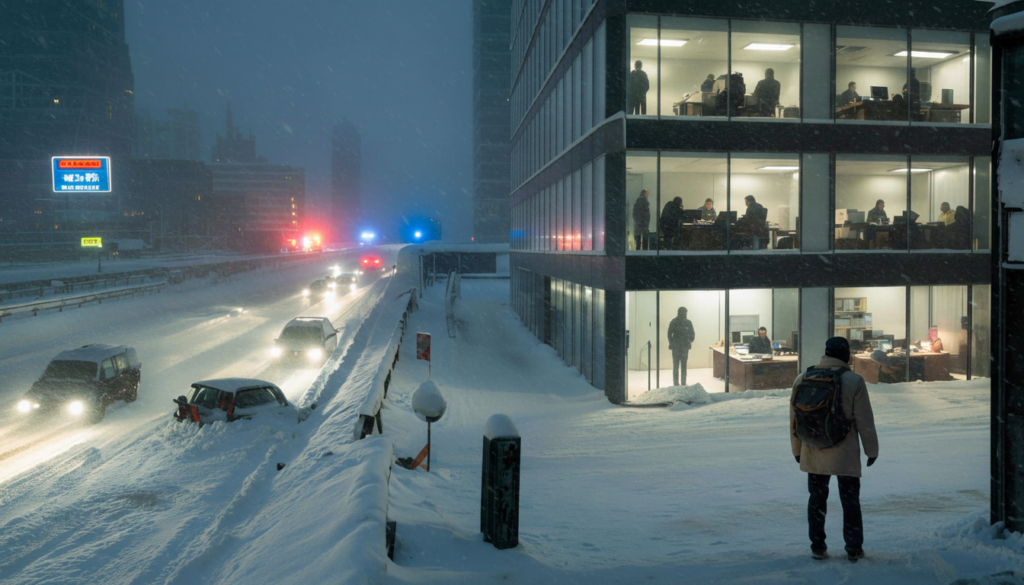
An alert from the transport ministry on one screen said, “Avoid all non-essential travel after 8 p.m.” On the other, a reminder for the calendar: “Tomorrow’s team meeting is mandatory and in person.”
You can almost feel the question that everyone is asking in the air.

When the snow starts to fall, who gets to decide what’s “essential”?
When the weather says to stay home and your boss says to come in
The messages are already conflicting. Authorities are saying the same thing over and over on TV and social media: there will be a lot of snow tonight, and the roads will be whiteout conditions. Only go out if you have to. At the same time, corporate emails are filling up inboxes with carefully worded messages that sound calm, polite, and very stubborn. “Our offices are still open as usual.” “We expect business to go on.”
Ploughs are lining up on the ring roads. Salt trucks are spraying like they’re in a race to the finish line. Drivers finish their coffee a little faster, their eyes going back and forth between the darkening sky and the time on their phones.
No one wants to be the first to say, “Maybe we should just not go.”
Think about what happened last January in a logistics hub in the Midwest. For 36 hours, forecasts had been warning of blizzard conditions, black ice, and almost no visibility. After 7 p.m., emergency services begged people to stay off the highways. The state DOT sent out red maps on all of their platforms.
But some big warehouses sent out a different message: “strongly expected” attendance, night shift still on, and trucks still rolling. In four hours, the local sheriff’s department reported more than 90 accidents by midnight. One of them was three workers from the same place who carpooled in a small sedan and spun out on an exit ramp that hadn’t been ploughed.
The next day, the company made a statement. It talked about “unforeseen conditions.” The screenshots of the forecast told a different story.
This split-screen reality is not an accident. People judge public officials by how many people make it home safely. People judge big businesses by how many orders they get, how many hours the production line runs, and how many calls they answer. When the snow starts piling up quickly, those incentives don’t all point in the same direction.
There is also a quiet fear that comes with work culture. No one wants to seem “weak” or “difficult” by saying they don’t feel safe driving. People then tell themselves that the warnings are too strong or that their car is “pretty good in the snow.” Black ice doesn’t care what kind of car you drive, where you work, or how good your winter tires are. *Physics doesn’t care about performance goals.
What you can really do when the storm is coming and the email says “see you tomorrow”
One simple move can change the whole script: act early, not at the last minute. As soon as the heavy snow alert pops up on your phone, send a clear, calm message to your manager. Two or three lines are enough. “I’ve seen the official travel warning for tonight and tomorrow morning. Roads in my area tend to ice over fast. I’d like to work from home / shift my hours / call in remotely so I’m not driving during the worst of it.”

Propose a specific alternative, not just “I don’t want to come in.” Offer what you can do: log on earlier, stay later once the snow clears, swap shifts with someone who lives close enough to walk. You’re not refusing to work. You’re refusing to gamble your life driving blind on a sheet of ice.
If you’re reading this and thinking, “My boss will roll their eyes and tell me to stop overreacting,” you’re not alone. We’ve all been there, that moment when the group chat is swapping radar screenshots and your manager is acting like it’s a light drizzle. That disconnect stings, because it’s not just about weather. It’s about your sense of being seen as a human, not just a body in a chair or a name on a rota.
Let’s be honest: nobody really does this every single day. People swallow their worries, throw a scraper in the trunk, and hope for the best. The risk is that tonight is the night hope isn’t enough. Especially when everyone else is doing the same nervous calculation at the same time.
- Before the snow hits – Screenshot official warnings, note the timestamps, and keep messages from your employer about attendance. This gives you a factual base for any conversation later.
- During the evening and night – Check live traffic cams or local community groups instead of just apps. People on the ground will often flag blocked exits or abandoned cars before maps do.
- Morning-of decisions – If plows haven’t passed your street, or you can’t see lane markings, treat that as real data, not “just a bit of snow.” Call in, refer to the public advisory, and repeat calmly that you won’t risk driving.
- For shift and gig workers – Ask in writing what happens if you follow a government “stay off the roads” request. Some employers quietly allow remote or delayed starts if you push for clarity.
- Longer term – Note each big storm and your employer’s response. Over a season, a pattern appears, and that pattern can guide whether you stay, speak up collectively, or start planning an exit.
Snow, power, and the quiet right to say ‘no’
Heavy snow has a way of showing who holds power, and who’s expected to just “deal with it.” On one side, public safety messages flood your apps, speaking in the language of care and caution. On the other, corporate memos slide into your inbox, wrapped in the language of commitment and resilience, hinting that real team players push through. Somewhere between those two tones, your own voice can get lost.
Yet storms like this are a rare chance to listen to that voice. To notice how your body tenses when you imagine driving home on a white, empty highway in the dark. To clock who in your workplace shrugs and who quietly offers rides, swaps shifts, or says “log in from home, we’ll figure it out.”
Snow doesn’t last. It melts, drains away, gets shoveled into dull grey piles and forgotten. The way people and companies act during it does not. That stays. It becomes part of how you remember your job, your city, and yourself the next time the sky turns that particular shade of stormy white and the forecasts start blinking red.
| Key point | Detail | Value for the reader |
|---|---|---|
| Recognise conflicting messages | Authorities may say “stay home” while employers insist “business as usual.” | Helps you see the pressure for what it is, not as a personal failure or overreaction. |
| Act early and concretely | Contact managers before the worst of the storm with clear alternative plans. | Increases your chances of a safer arrangement without last-minute panic. |
| Track patterns and responses | Note how your employer behaves during each major storm over time. | Gives you evidence to push for change or decide if this workplace aligns with your safety. |
FAQ:
Question 1: Can my boss really make me drive to work when there is a heavy snow warning?
Question 2 : What should I really say when I call in because the roads are dangerous?
Question 3: If I don’t drive in a snowstorm, do I have any legal protection?
Question 4: What can I do to get my car and my schedule ready before the snow comes?
Question 5: What if my job really can’t be done from home, like retail or healthcare?