Saturday night, Paris suburbs. The candles are lit, the pasta’s on the stove, friends are arriving in dribs and drabs. Except… nobody is sitting in the living room. The big corner sofa, once the star of the “séjour”, stays almost empty. Everyone has gathered somewhere else: around a big wooden table, between the kitchen island and a sort of long, generous table where plates, laptops and school notebooks happily mix all week.
The old-fashioned “living-dining room” duo, with the TV on one side and a formal table on the other, is quietly being abandoned in French homes.
People want something warmer, simpler, more flexible.
And it’s changing the whole layout of our homes.
From living-dining room to one big “living table”
Walk into a lot of new French flats now and you’ll notice something striking.
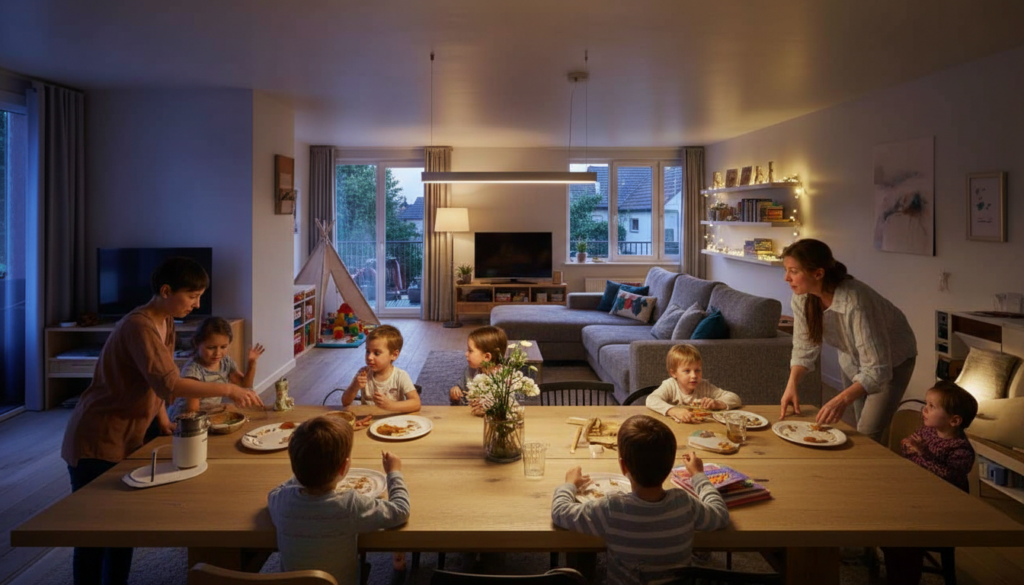
The classic rectangle with the sofa in front of the TV, then the dining area behind, like a hotel restaurant, is vanishing. In its place: a large, friendly space that revolves around a central table, often stuck to or facing the kitchen.
The room looks less “decorated” and more lived-in. There’s a laptop next to a fruit bowl, a school bag on a bench, a vase that someone forgot to refill. This is the new social nerve centre: less show, more life.
In Lille, 37-year-old Laurie recently broke a sacred French rule. She got rid of her separate dining room.
“I realised we only used it twice a month, and the rest of the time it was a laundry room with chairs,” she laughs. She knocked down a partition, sold the buffet, and invested in a huge oak table that now connects the kitchen to the lounge area. On Sunday mornings, her children draw there while her partner makes pancakes. On Wednesday nights, it becomes a homework zone. On Friday, it’s apéro with neighbours.
The TV corner shrank, the table grew, and the mood of the home shifted.

Why this shift? Because life has moved away from formal meals and “receiving guests” like in a showroom.
People work from home, kids spread out their toys, friends come over more spontaneously. The living room that looks like a furniture catalog no longer matches reality. *A big, shared, central table allows for all of that in one place, without constantly reshuffling the house.*
The French “séjour” is morphing into what many decorators now call a “pièce à vivre totale”: one hybrid space where cooking, chatting, working and playing blend into a single, more sociable zone.
Designing a sociable space: think table first, sofa second
If you’re rethinking your space, start with one question: where do people naturally gather at your place?
Nine times out of ten, the answer is “near the kitchen”. That’s your goldmine. Anchor your whole room around a generous central table there: not necessarily huge, but solid, comfortable, with chairs that invite lingering. Then organise the rest around it, like a little universe gravitating around a sun.
The sofa can slide to the side, almost like a lounge corner attached to this central social hub, not the other way round.
Many people still do the opposite and regret it. They invest in a gigantic corner sofa, orient everything towards the TV, and then squeeze in a table “where it fits”. Result: dinners that feel secondary, guests stuck between a wall and a radiator, kids doing homework half on their knees.
We’ve all been there, that moment when you’re ten around a tiny table pulled out from the wall, elbows colliding, plates getting cold. The truth is, the space is often there, just badly prioritised.
The new social trend flips the script: eat, chat, work, play at the centre, watch series on the side.
“Since we redesigned our space around the table, people stay longer,” says Karim, 42, from Lyon. “Before, we ate quickly then slumped in front of the TV. Now conversation just carries on. The TV is there, but it’s no longer the boss of the room.”
It’s a subtle shift, but it changes the whole social rhythm of the house.
- Choose a table that fits your real life, not your fantasy of Christmas dinner
- Put the table in the brightest spot, even if that means moving the sofa
- Use benches or mixed seating to save space and add a relaxed feel
- Keep circulation paths clear so people can walk around the table easily
- Plant a small lamp or pendant above: light naturally draws people in
The end of the “good room” and the rise of the everyday room
What’s disappearing with the living-dining room is also a whole way of seeing the home.
The old “good room” reserved for Sundays and guests, always tidy, always a bit stiff, is making way for an everyday shared room that dares to show real life. Crumbs, schoolbooks, board games: all on the same surface where you’ll serve dinner at night.
Let’s be honest: nobody really clears everything away beautifully three times a day.
This new trend accepts that a sociable space is a used space, and that’s precisely what makes it warm.

| Key point | Detail | Value for the reader |
|---|---|---|
| Central table | Place it by the kitchen and in the best light | Makes everyday life and get-togethers easier |
| Shrunk TV area | Smaller sofa or corner layout, secondary to the table | Encourages conversation rather than passive evenings |
| Flexible seating | Benches, chairs, stools mixed around the table | Hosts more people without crowding the room |
FAQ:
Is the living-dining room totally outdated now?
Not completely, but it’s losing ground. Many French households still have it, especially in older homes, yet the trend in renovations and new builds is clearly towards one large, hybrid living space centred on the kitchen and table. This shift reflects a desire for more fluid daily living and a less formal atmosphere.
What if my living room is very small?
Go for a medium table that can extend, with two good chairs and maybe a bench against the wall. Place the table where it gets light, and pick a compact sofa or even two armchairs rather than a bulky corner sofa that eats the whole room. Small spaces benefit from smart, flexible furniture and a clear social focus.
Can I keep a TV and still have a sociable layout?
Yes. The idea isn’t to ban screens, just to stop organising everything around them. Put the TV on a side wall, or on a mobile stand, so conversation and meals stay at the centre, and screen time becomes just one of the room’s uses. This creates a balanced, multipurpose space with a healthier social dynamic.
Is a kitchen island enough to replace a table?
For some singles or couples, yes. For a family or anyone who loves hosting, a proper table is more comfortable. You can still pair a small island for cooking with a friendly table that sets the tone for gatherings. A table offers longer, more comfortable seating and a stronger sense of togetherness.
How can I shift to this trend without doing major works?
Start by moving furniture: bring the table closer to the kitchen, reclaim the best-lit spot, reduce the footprint of the TV corner. Sometimes just swapping the position of the sofa and table completely changes the social energy of the room. Small moves can create a big shift in atmosphere and a more welcoming layout.