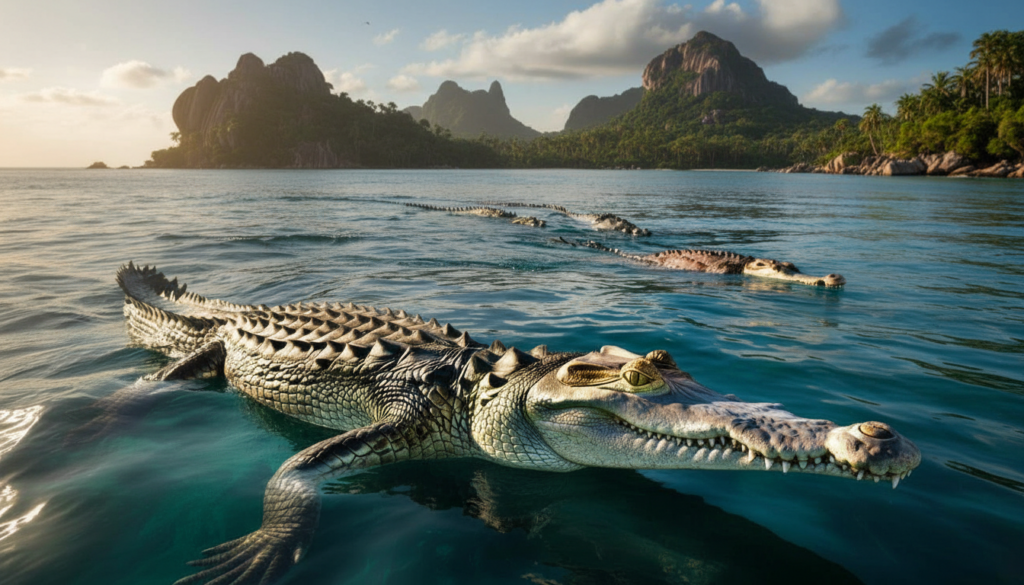
For hundreds of years, the Seychelles’ crocodiles were ghosts, known mostly from old travel notes and a few dusty bones in museums. Records of early European expeditions from over 250 years ago say that there were a lot of crocodiles on the islands. By the end of the 1700s and the beginning of the 1800s, people who wanted to clear the coasts were living next to those animals.
Settlers thought crocodiles were dangerous to people and animals. They hunted them down in lagoons, rivers, and mangroves in a planned way. The reptiles were gone from the whole archipelago in just a few decades. A few skulls and teeth were all that was left. They are kept in collections in the Seychelles, London, and Paris.
At first, most Western zoologists thought these animals were Nile crocodiles, which are common in Africa along the continent’s big rivers. That made sense with the geography, and no one had any reason to think anything was wrong.
It wasn’t until the 1990s that a close look at the bones showed a twist: the Seychelles crocodiles looked more like saltwater crocodiles than Nile crocodiles.
That change in classification was only based on anatomy. The new study finally gives those skeletal clues some genetic substance.
DNA backs up a 7,500-mile saltwater empire
An international team used modern genetic tools to look at those museum specimens again in the most recent study, which was published in the journal Royal Society Open Science. They took small samples from skulls and teeth, got mitochondrial DNA from them, and then compared it to genetic data from living crocodiles all over the Indo-Pacific.
Mitochondrial DNA, which comes from the mother, is often better preserved in older remains and helps us learn about the history of populations over long periods of time.
The outcome was unequivocal: the Seychelles animals were distinctly categorized within the saltwater crocodile group, rather than with Nile crocodiles or any distinct species.
The genetic markers show that Seychelles crocodiles were part of a large group of saltwater crocodiles that lived across a wide area, from east to west, about 12,000 kilometers.
This means that saltwater crocodiles used to live in a much larger area of the Indian Ocean than they do now, before humans killed them all off. People know about modern saltwater crocodiles in India, Southeast Asia, northern Australia, and many islands in the Western Pacific. It looks like the Seychelles population was at the very western edge of that huge range.
Riding the waves in the Indian Ocean
That makes the obvious question: how did these big reptiles get to an island chain that was so far away from everything else?
The people who wrote the study say that the people who started the Seychelles population must have crossed at least 3,000 kilometers of open ocean. They might have gone even farther, drifting and swimming with the currents for weeks or months.
Saltwater crocodiles are surprisingly good at traveling in the ocean. They have special salt glands on their tongues that help them get rid of extra salt and stay in seawater for long periods of time.
The salt glands in these animals change them from coastal ambush predators to roaming mariners who can hop between river mouths and island groups with the tides.
Tracking work done in other places has shown that individual saltwater crocodiles can swim hundreds of kilometers at sea, usually following currents and staying close to shore. The new DNA evidence suggests that these kinds of trips have been happening for a lot longer, connecting people from Africa’s doorstep to the Pacific islands.
Why the crocodiles stayed the same type
One notable result of the study is the absence of distinct genetic divergences among remote saltwater crocodile populations. Even though the distances are huge, the mitochondrial patterns suggest long-term connections and gene flow.
That mixing helps explain why saltwater crocodiles haven’t evolved into different species over their large range. People who traveled long distances from time to time, like the people who started the Seychelles population, would have brought genes from one place to another, which would have stopped deep isolation.
- Wide range: from the coasts of the Seychelles and India to northern Australia and the Pacific Islands.
- Adaptation to the sea: Salt glands on the tongue make it possible to live in seawater.
- High mobility: People can ride ocean currents for thousands of kilometers.
- Limited speciation: Gene flow over long distances keeps populations genetically linked.
The researchers emphasize that mitochondrial DNA represents merely a portion of the narrative. It shows the mother’s history, not the full genetic contribution from both parents. Scientists may still find small differences between regions when they look at nuclear DNA, which is passed down from both the mother and the father and is found in the nucleus of the cell.

Future work: concealed diversity or a singular, wandering giant?
Future studies, utilizing nuclear genomes from both contemporary and historical specimens, may elucidate whether Australian crocodiles, for example, are genetically distinct from those in proximity to India or Southeast Asia, despite presenting as a singular roaming population in mitochondrial data.
For conservation, that kind of detailed genetic mapping is important. Some island groups may need special protection if they have unique lineages, especially in areas where crocodiles are threatened by habitat loss or conflict with people.
What seems like a single widespread species may actually be made up of several regional lineages that are only slightly different from each other and have their own evolutionary stories.
People come, and the crocodiles go away.
The new study shows how good crocodiles are at crossing oceans, but it also shows how quickly human activity can wipe out even the strongest colonizers. There was almost always going to be conflict when people moved to the Seychelles. Crocodiles live in the same coastal areas where early communities fished, farmed, and built their homes.
Accounts from the 1700s and 1800s talk about severe persecution. People shot, trapped, and drove crocodiles away from their nesting areas. They didn’t have much of a chance of surviving because they didn’t have any legal protection and their habitat was limited.
The Seychelles case is part of a larger trend. Large predators, especially those that can hurt people or livestock, tend to disappear quickly after people arrive, whether on islands or on the coasts of continents. In the Seychelles, this meant that a group of animals that had survived crossing the open ocean and thousands of years of climate changes would no longer exist.
Why biologists are interested in saltwater crocodiles
Saltwater crocodiles are interesting to scientists in many fields, including evolution, biogeography, conservation, and even climate resilience. They are top predators that change ecosystems by controlling how many fish, birds, and mammals there are and how they act. They also connect freshwater and marine food webs by moving nutrients from rivers, estuaries, and coastal seas.
Researchers can better understand how species spread across oceans without human help by looking at their movements over time. This, in turn, improves models for how other coastal animals, like monitor lizards and mangrove trees, may have settled on islands over a long period of time.
| PartRelated to saltwater crocodiles | |
|---|---|
| Ocean currents work like “conveyor belts” to move people over long distances. | |
| Change in sea levelLower sea levels in the past opened up more coastal habitat and possible stepping-stone islands. | |
| People living thereRapidly contracts range through hunting and habitat loss | |
| Genetic linksKeeps one species alive over long distances, even when it goes extinct in some places. |
Important words and what they mean
This research is based on a few technical terms, but they all come down to simple ideas.
Mitochondrial DNA (mtDNA) is the genetic material that is found in the mitochondria, which are the cell’s “power stations,” not in the cell’s nucleus. There are many copies of mtDNA in each cell, which helps it stay alive in old or damaged samples. It is often used to follow maternal lineages over time because it usually only comes from the mother.
The main genetic code in chromosomes in the cell nucleus is nuclear DNA. It combines information from both parents and gives a more detailed picture of the genetic differences between groups of people.
The term “range” describes the entire area where a species naturally lives. The new study says that the historic range of saltwater crocodiles was much bigger than what we see today.
What this means for wildlife on the islands today
When you think about the Seychelles crocodiles, it makes you wonder about the big reptiles and predators that live on the islands now. Many remote islands have species that got there in ways that are just as unlikely, like rafting on storm debris, following river plumes, or stepping from one now-drowned island to the next when the sea levels were lower.
Once these colonists move in, they often become important parts of their new ecosystems. Taking them out, like they did in the Seychelles, can change food webs and lead to other changes, like more prey animals or changes in plants.
The story of the saltwater crocodile is a reminder for modern conservationists that some species are more connected than they seem. A crocodile sunbathing in an Australian river might be related to one that used to live in a mangrove in the Seychelles. To protect that shared heritage, we need to think beyond borders and see coastlines and islands as parts of a single, changing Indo-Pacific system.