The French company Eiffage has been working on bridges and other big projects across the Rhine for years. Now, they are tightening their grip on Germany by buying a well-known local engineering firm. The move shows a clear shift in focus: from just winning contracts to becoming a part of the country’s daily construction ecosystem.
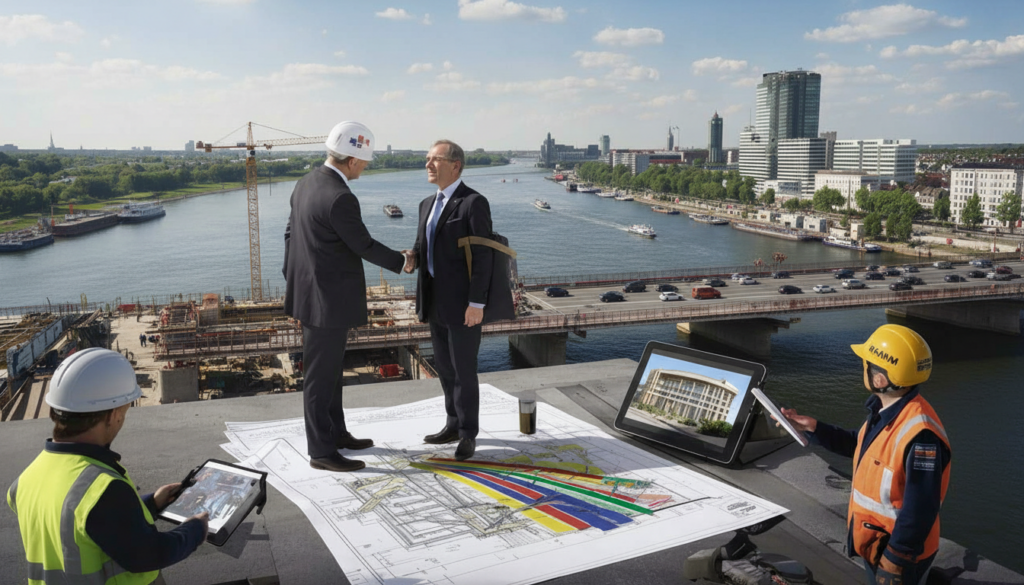
Eiffage’s quiet power move in Germany
Eiffage has long been known for its bridges, roads, and other big infrastructure. It is now the fourth-largest construction group in Europe by revenue. Germany has steadily become one of its top markets, and that strategy is now speeding up.
In early 2026, the group said that its German subsidiary Salvia, which is part of Eiffage Énergie Systèmes, is buying HTW Engineers, a mid-sized but well-known engineering company in Germany. Even though the deal wasn’t called a huge takeover, it could change the way Eiffage does business north of the Rhine.

HTW Engineers gives Eiffage direct control over the “brains and nervous system” of modern buildings, not just their concrete frames.
Eiffage was mostly known in Germany for its big structural projects, like huge bridges, steelwork, and heavy engineering. By adding a local building services expert, the group goes from being a foreign contractor to a more integrated player that can compete on German terms, in German cities, with German engineering talent.
Who is HTW Engineers, the company that Eiffage just bought?
Outside of professional circles, HTW Engineers isn’t very well known, but in Germany it has built a strong reputation over the years.
Established: 1969
Its main business is everything that needs to be done after the concrete and steel are in place to make a building work:
Plumbing and water treatment systems
HVAC stands for heating, ventilation, and air conditioning.
Power distribution and electrical engineering
Systems for security, fire safety, and control
BIM (Building Information Modelling) for digital design that works together
One way to think about it is that the skeleton of a building is the frame, and HTW Engineers designs the circulatory and nervous systems. Even the most beautiful building is just a dead shell without that layer.
Flagship projects that show what HTW does
Monheimer Tor in Monheim am Rhein is one project that the company talks about a lot. The site is being turned from an old shopping center into a mixed-use urban center that will have:
A hotel with 142 rooms
A parking garage with more than one floor
More stores and services
A movie theatre with six screens
HTW Engineers’ teams take care of the technical backbone that keeps this hybrid complex running smoothly day and night. This includes energy-efficient heating and cooling, smart ventilation for cinemas, reliable electricity networks, and security that works for both shops and hotel areas.
For Eiffage, buying a company that builds this kind of multi-use building is a way to get involved in Germany’s ongoing urban renewal projects, which focus on upgrading, densifying, and reusing existing sites instead of building new ones.
Salvia goes from executor to technical genius
Salvia, Eiffage’s German branch that works on energy systems, has already done installation and technical work all over the country. Its role changes a lot when HTW Engineers are on board.
The acquisition moves Salvia up to the design phase, where decisions are made about long-term costs, energy use, and maintenance.
More and more German clients, especially public bodies and institutional investors, prefer “design-build” contracts. In this model, the same group of people designs, plans, and builds the project instead of splitting the work between architects, engineers, and contractors.
Salvia can now do the following by bringing HTW Engineers on board:
Set the rules from the start, not just follow them.
Improve energy efficiency and lifecycle costs over the course of decades
Make sure that your design choices fit with how Eiffage builds things.
Give clients a single point of contact for complicated plans.
This type of vertical integration usually locks in a higher value for each project. It also makes customers more loyal because switching suppliers usually means starting over with important technical systems.
Big bridges, big statement: Eiffage’s history in Germany
The HTW deal didn’t just happen. Eiffage has quietly taken on some of Germany’s most visible infrastructure jobs over the past few years, especially in steel bridges.
Project Location Contract value Key numbersDelivery
Replacement of the Levensau Bridge over the Kiel Canal cost €183 million, with €82 million going to Eiffage. The bridge is 241 meters long, 42 meters high, and made of 10,000 tonnes of steel. It is designed to last for many decades.
A1 Rhine Bridge in Leverkusen, Rhineland, motorway A1, costs €358 million (including €126 million for Eiffage). It will have 2×4 lanes, 16,000 tonnes of steel, and will be demolished and rebuilt. The goal is to finish by the end of 2027.
Some of the busiest roads and shipping lanes in Germany cross these bridges. They show how much money Berlin is willing to spend and how open it is to bringing in foreign groups to do hard technical work.
Eiffage’s presence now goes beyond the impressive steel structures that cross rivers to include the more everyday engineering work that happens in offices, hotels, public buildings, and shopping malls.
Why a French builder cares so much about Germany
With a turnover of about €143.5 billion and about 75,000 companies as of 2021, Germany has the biggest construction market in Europe. Demand is less for new housing developments and more for fixing up old, run-down buildings and improving infrastructure.
Energy retrofits are now a big deal. The public development bank KfW is pushing for renovations by giving out loans and grants, which add about €8.6 billion to the sector. That channel alone has a big impact on design and engineering work.
Germany is like a real-life lab for companies that can combine good engineering with long-term energy efficiency goals.
Eiffage now covers a wider range of things in this lab, from steel structures and bridges to heating, cooling, electricity, and digital modelling inside buildings. In real life, that means it can bid on mixed portfolios, like a bridge here, an urban renewal project there, and service contracts for the technical systems that keep assets running.
Where Eiffage stands in the European construction league table
Eiffage is one of the best builders in Europe based on its recent sales:
Vinci, France
Bouygues (France)
ACS (Spain)
Eiffage (France)
Strabag (Austria)
Skanska (Sweden)
Acciona and Ferrovial (Spain)
Webuild (Italy)
Balfour Beatty (UK)
Eiffage’s move in Germany shows that it doesn’t want to stay in fourth place for long. Getting technically advanced business in the EU’s biggest economy is also a way for France to protect itself against future slowdowns or changes in public spending.
What this means for clients and projects in Germany
The arrival of a more integrated Eiffage-Salvia-HTW package adds competition to an already crowded market for German cities and developers. Local engineering companies may feel pressure, but some may find new partners on bigger or riskier projects.
Clients can benefit from having a group that can:
Be in charge from the design phase to the commissioning phase
Use BIM to better coordinate structural and technical trades.
Improve building systems to meet energy goals set by KfW programs.
Give long-term guarantees on maintenance and performance
On the other hand, this makes you more reliant on one supplier, which is something that public buyers in Germany tend to be very careful about. The level of integration will depend on how well the contract is written, how clear the costs are, and how well the performance clauses work.
Design-build, BIM, and energy renovation are important ideas
Design-build and BIM are two technical terms that are at the heart of this story and often confuse people who aren’t experts.
Design-build is a way to deliver a project in which one group or consortium does both the design and the construction. That can speed things up and cut down on arguments because the same team that makes the plans is also in charge of building them. It means that Eiffage and HTW make engineering and construction decisions all in one place.
Building Information Modelling (BIM) is a digital, 3D model that shows not only the shape of a building but also information about its materials, performance, costs, and upkeep. Eiffage can use HTW’s BIM skills to try out different heating systems, insulation levels, or ventilation layouts before work begins. This lets them see how energy bills or comfort levels change over time.
BIM can help a city compare two options for a 1970s office block during an energy renovation. One option is to keep the current gas boiler and add insulation, and the other is to switch to a heat pump system with new ventilation. The model can show payback times, CO₂ reductions, and expected maintenance schedules. This gives decision-makers a clearer picture than traditional paper plans.
As Germany makes building rules stricter to meet climate goals, those simulation tools become just as useful as cranes and concrete mixers. Eiffage’s bet is that owning that knowledge will be better in the long run than renting it out for each project.