The memory clinic waiting room looks a lot like a co-working space on Tuesday mornings.
Two women in their 40s are sharing a phone charger. A man in a hoodie is looking through his emails on his laptop. A woman in her early 50s with a school backpack on her lap is looking at the clock as if she might be late to pick up her child.
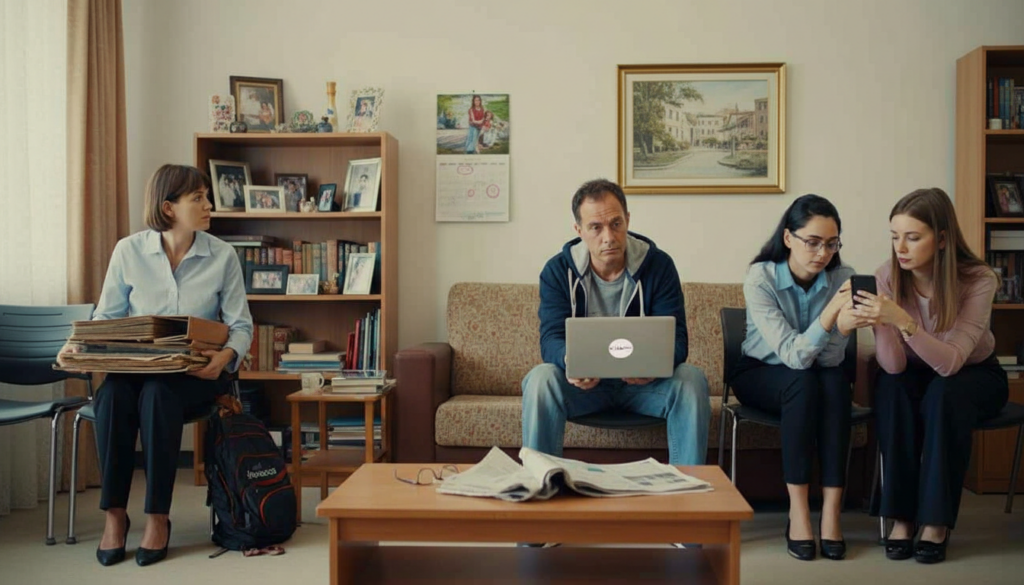
Then a nurse opens the door and calls out a name, and the illusion breaks.
These people aren’t here for a regular check-up or to talk about work stress.
They came here because they keep forgetting their passwords, burning pans, and losing words in the middle of a sentence at 48, 52, and 57.
Alzheimer’s that starts early.
Under 60, and already living with what many people still think of as “a disease of the very old.”
The diagnosis isn’t always the scariest part.
Sometimes, it’s the feeling of being alone when they walk back out onto the street, where no one can see what’s slipping away.

When Alzheimer’s comes too soon by decades
Most families are shocked by something other than the memory loss.
The medical file has the person’s birth year on it. 1968, 1971, 1980.
These are people who still have kids in middle school.
Careers that were just starting to take off.
Mortgages, a running club on Thursday nights, and group chats full of memes.
Then one day they can’t find their way home on the same road.
Or they forget the name of a coworker they’ve worked with for ten years.
At first, everyone laughs it off.
Not enough sleep and too much work, right?
Marie, 54, is a project manager. She has two grown children and a teenager who still lives at home.
She joked for months about “pregnancy brain coming back” because she kept asking the same questions at dinner.
When she sent the wrong version of a file twice in one week, her team covered for her.
After that, she stopped going to appointments.
The day she went to the wrong school for her son’s parent-teacher meeting, which was miles away from their neighbourhood, fear finally broke through the humour.
Her neurologist didn’t say the word “Alzheimer’s” for almost two years.
For two years, they told me it was stress, depression, hormones, or anything else.
At that point, she had already stepped back from promotions because she was worried she wasn’t “sharp enough” anymore.
Doctors think that 5 to 10% of Alzheimer’s cases are “early-onset,” which means they happen before age 65.
That sounds small, but when you think about it, it’s a lot: people in their 40s and 50s suddenly kicked out of the world they built.
Younger patients often get the disease faster.
Their brains are more active and in demand, so the gaps show up sooner at work, as parents, while driving, handling money, and even on social media.
Even professionals and families can get the signs wrong.
People call personality changes “burnout.”
People say they forget things because they are “busy and distracted.”
The family has already been confused and guilty in silence for months or years by the time the right specialist comes along.
*They know something is wrong, but they don’t know how to say it yet.*
Living each day with a brain that is getting older and weaker
There is a new way of living that no one ever practiced for behind every early-onset diagnosis.
A 52-year-old man who now sets three alarms to remind him to pick up his daughter.
A 49-year-old who puts labels on every kitchen drawer because she can’t remember how they are arranged anymore.

From the outside, the little tricks look almost like they belong to kids: Colour-coded calendars, voice memos for tomorrow’s to-do list, and Post-it notes on the fridge.
But these are the tools that keep independence going for another month, another year.
Neurologists often suggest very specific routines.
Put your keys in the same basket every time.
Use a pill box that has the days of the week on it.
Instead of a thousand little scraps that will never be found again, keep one notebook and write everything in it.
Memory loss isn’t the only thing that hurts people in their 40s and 50s.
They feel like they’re “a burden” when they’re still supposed to be the strong one in the family.
Partners become carers overnight, making sure the gas is off, taking care of the budget, driving everywhere and answering uncomfortable questions at family events.
When kids realise that Mom needs help finding words or Dad can’t follow the plot of a movie anymore, they grow up quickly.
Let’s be honest: no one really does this every day with perfect patience and grace.
There are slammed doors, short answers, and nights spent scrolling through forums at 2 a.m. looking for someone who really gets it.
And a constant, quiet fear: Will tomorrow be worse than today?
Thomas, who was diagnosed with Alzheimer’s at 57 while still working in IT, says, “People think Alzheimer’s is forgetting your grandchildren’s names at 85.”
“They don’t see a guy like me who used to fix servers forgetting the Wi-Fi password three times a week.”
I didn’t just forget things. I lost the version of me that I loved being.
- Say the diagnosis out loud.
Saying the name of Alzheimer’s takes away the shame and makes it possible to get real help instead of just vague worry. - Get the paperwork in order early.
Powers of attorney, access to bank accounts, and work contracts: doing these things while the person is still clear-headed will help avoid problems later. - Find out what the person still wants to do.
Planning trips, hobbies, and projects now gives you back a sense of control and respect. - Take care of the carer too
The person helping needs a life outside of the disease, too. They need therapy, respite care, and a few hours off each week. - Be honest with kids and use simple words.
When you don’t say anything, wild fears can grow. Clear explanations help them love without fear.
A disease that makes us rethink our age, memory, and future
When Alzheimer’s strikes before age 60, it doesn’t just change one life.
It makes us question everything we think we know about age, how productive someone is, and what makes them valuable.
We usually respect how forgetful very old people are.
Even if it’s awkward, we make room for it.
Society is harder on people who are 52 years old.
Co-workers talk about “competence” behind each other’s backs, friends stop talking to each other because “it’s too hard to see them like that,” and companies quietly push people out instead of changing their roles.
People who live in this reality often say something similar: they don’t want pity.
They need time.
It’s time to teach them their skills in a different way.
It’s time to be there for their kids, even if they tell the same stories over and over.
Time to love, to laugh at their mistakes, and to be more than just a diagnosis.
| Key point | Detail | Value for the reader |
|---|---|---|
| Early-onset exists | Alzheimer’s can appear in the 40s and 50s, not only after 80 | Helps recognise signs sooner and push for proper medical assessment |
| Practical routines matter | Simple tools like notebooks, alarms and fixed habits support autonomy | Offers concrete ways to live with the disease day to day |
| Caregivers need care | Partners and children are heavily impacted emotionally and financially | Encourages readers to seek and accept support, not carry everything alone |
FAQ:
Question 1: Is it possible for Alzheimer’s to start before age 60?
Question 2: What early signs should make you see a doctor?
Question 3: Is early-onset Alzheimer’s always passed down through genes?
Question 4: Can people with Alzheimer’s who are under 60 still work?
Question 5: How can friends help someone with early-onset Alzheimer’s without being pushy?