That calm goes away when you look closer. This new Hubble Space Telescope picture shows a nearby cosmic cloud full of new stars, swirling gas, and invisible violence. It is a stellar nursery that is busy making future suns, planets, and maybe even distant homes for life.
A dark cloud that hides a bright secret
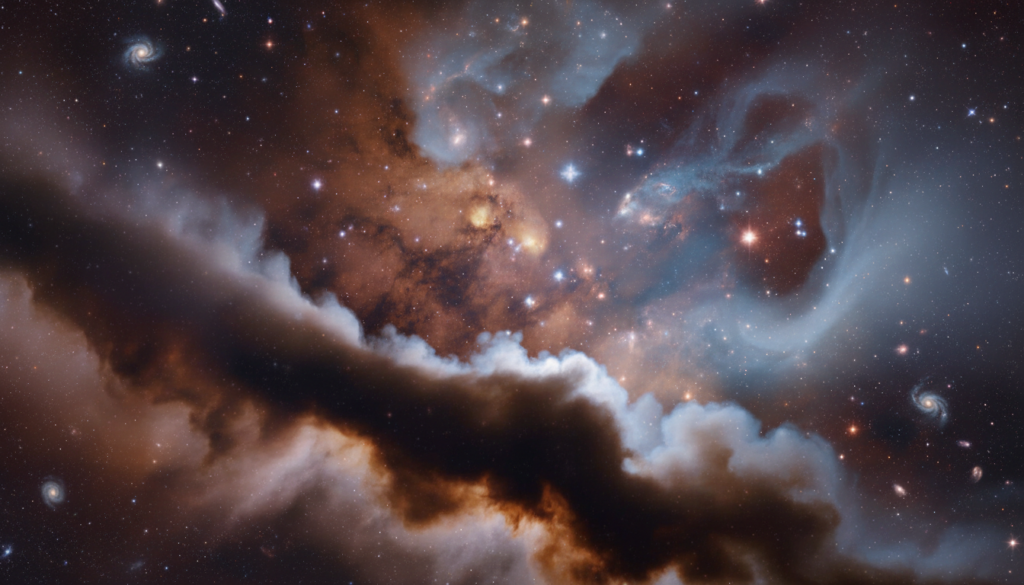
The picture shows Lupus 3, a thick molecular cloud in the constellation Scorpius that is about 500 light-years away. For many people on Earth, it is low in the southern sky on a clear night, but its structure is too faint to see with the naked eye.
Lupus 3 looks like a calm line of darkness, but inside it, gravity is pulling cold gas together to make new stars.

A thick, inky band of dust cuts across space in the lower left of the picture, blocking starlight from the background. This is the heart of the cloud, where the temperature drops and hydrogen, helium, and dust come together to form dense knots. Those knots are the seeds of stars that will come in the future.
Like smoke curling from a fire, pale, blue fingers of light are coming out of that dark mass. These are reflection nebulae, where dust grains scatter light from nearby young stars. This makes a black patch of space look like a ghostly glow called GN 16.05.2 or Bernes 149.
The T Tauri stars are like new suns.
T Tauri stars are the real stars of the show, and they are all over this area. Hubble sees them as bright, sometimes slightly yellow-white dots, especially near the top left, bottom right, and upper middle of the frame.
T Tauri stars are like teenagers in space. They are less than 10 million years old and are still figuring out how to be adults.
There are a few reasons why astronomers pay close attention to these stars:
They are young because they just formed from gas clouds that were collapsing.
They are not stable because their brightness changes a lot over days, weeks, and years.
They are dirty because strong winds and flares blow things out, and gas and dust keep falling on them.
They give us a hint about our own past: The sun probably went through a T Tauri phase more than 4.5 billion years ago.
T Tauri stars are still getting smaller because of their own gravity, unlike mature stars that shine steadily. Nuclear fusion, the process that will power them for billions of years, is just starting to happen deep inside their cores. As that inner engine settles down, the star’s light output flickers and flares.
Some of those outbursts are caused by strong magnetic fields. A T Tauri star can let out huge flares and grow big “starspots,” just like our sun does when it’s too active. As the star spins, these darker spots move in and out of view, which causes the brightness to change over time.
Hubble’s sharp eye on a star nursery
From the ground, most of this drama is still hidden. Dust takes in and spreads out visible light, making places like Lupus 3 look like dark shapes, even through big telescopes on the ground. Hubble has a big advantage because its optics are so sharp and it is above the atmosphere.
Hubble can see through the dust to see stars forming by looking at Lupus 3 at different wavelengths.
The Wide Field Camera 3 and other instruments that Hubble’s 2.4-meter mirror sends light to can see both visible and near-infrared wavelengths. Astronomers can see stars that are still wrapped in parts of their birth cocoons because infrared light can get through dust more easily.
With those capabilities, Hubble has built a catalogue of stellar nurseries, including:
| Region | Type | Notable feature |
|---|---|---|
| Lupus 3 | Molecular cloud | Nearby population of T Tauri stars |
| Orion molecular cloud | Giant star-forming complex | Famous Trapezium cluster and bright Orion Nebula |
| Rho Ophiuchi | Dark cloud complex | Closely packed infant stars wrapped in dust |
| Taurus molecular cloud | Nearby low-mass star factory | Rich in protoplanetary discs |
| Eagle Nebula (M16) | Emission nebula | Iconic “Pillars of Creation” columns |
Researchers can see how star formation changes from one place to another by comparing Lupus 3 to these other areas. Some clouds make huge stars that only last a few million years before burning out. Some, like parts of Lupus 3, mostly make smaller, longer-lived suns that are more like our own.
A connection to the beginning of our solar system
These pictures are more than just wall art for space. They show what the solar system might have looked like before Earth was formed.
The sun probably formed in a crowded stellar nursery like Lupus 3, where it was surrounded by siblings and wrapped in gas and dust.
New stars would have blasted each other with radiation and stellar winds in that old cloud. Nearby massive stars or even supernovae may have sent shock waves through the gas, causing new stars to form and shaping the disc that became our solar system.
Today, astronomers use computer simulations to add detailed observations of Lupus 3 and places like it. Those models show how gas moves from a cold cloud to a star’s birth and then to the clearing of dust. When the virtual star systems that form in the simulations look like real observations of exoplanets and young stars, it helps us learn more about how normal or strange our solar system might be.
What is a molecular cloud, really?
Lupus 3 is part of a group of things known as molecular clouds. These are huge pools of cold gas and dust where atoms have come together to form molecules, most often hydrogen molecules (H₂). They are the building blocks of almost all new stars in a galaxy.
A molecular cloud is defined by a few important characteristics:
Low temperature: Usually only a few tens of degrees above absolute zero.
High density for space: This gas is still very thin by Earth standards, but it is much denser than most interstellar gas.
Dust content: Small pieces of carbon and silicates that protect the gas from strong radiation and help it cool down.
Gravity starts to win when a part of the cloud gets a little denser, maybe because a shock wave passes through it. Gas collapses inward and heats up. If the clump is big enough, it eventually becomes a star and often a disc around it. Those discs are where planets can form.
How people who aren’t professionals can follow areas like Lupus 3
Lupus 3 is hard to see, but people who are really into stargazing can still use it as a target to learn about the sky. The bright red star Antares marks the constellation Scorpius, which is where the cloud is. Scorpius is one of the easiest constellations to find because it looks like a fishhook across the Milky Way. You can see it from dark places in the summer in the northern hemisphere and the winter in the southern hemisphere.
Dark nebulae in Scorpius and nearby constellations are great subjects for deep-sky photographers with small telescopes and sensitive cameras. They are also very difficult to photograph. Long exposures can show dusty lanes that are similar to the ones Hubble captures in great detail, but on a much smaller scale.
Why young stars that flicker are important
The flickering brightness of T Tauri stars in Lupus 3 is not just a strange thing to see. The changes give us information about the stars’ discs and magnetic fields. Astronomers can figure out rotation periods, starspot coverage, and the presence of orbiting material by looking at light curves, which are graphs of brightness over time.
In some cases, dips in brightness may even mean that groups of dust or small planets are passing in front of the star. That kind of behaviour makes it hard to tell the difference between studying how stars form and how planets form, which makes places like Lupus 3 living labs for both.
People who look at this Hubble picture might think that the blue haze and dark rifts are far away and almost abstract. But inside that hazy light is a story we all know: the same kind of cradle that made our sun and all the rocks, water, and life on Earth.